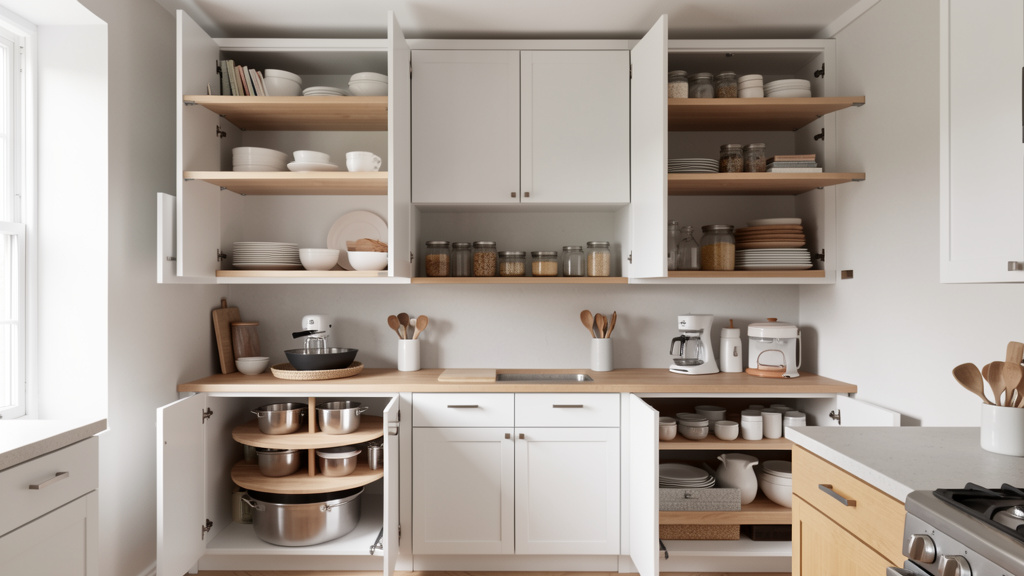
Stop wasting space. This step-by-step system transforms chaotic cabinets into a seamless, efficient storage ecosystem—without remodeling.
Tired of cramming dishes into overcrowded cabinets or digging through drawers for the one lid that fits? You’re not alone. Many kitchens fail to utilize their full storage potential due to overlooked zones, mismatched organizers, and workflows that fight human habits. This definitive guide delivers a practical, zone-by-zone framework to reclaim every unused inch—from the awkward toe-kick space beneath base cabinets to the forgotten vertical real estate inside cabinet doors. We break down adaptable solutions for rentals, tight budgets, accessibility needs, and uniquely shaped kitchens, grounded in ergonomic principles and widely observed implementation patterns. No fluff, no generic Pinterest lists—just actionable strategies that create lasting order.
Introduction: Why Your Kitchen Storage Feels Broken (And How to Fix It)
Walk into any home improvement store, and you’ll see gleaming displays of pull-out spice racks, tiered shelf organizers, and magnetic knife strips. Yet after installation, many homeowners report the same frustration: “It looked perfect in the store, but it doesn’t work in my kitchen.” This disconnect stems from a critical oversight in most storage advice—it treats organizers as isolated products rather than interconnected components of a personalized system. True storage efficiency emerges not from buying the “best” gadget, but from aligning solutions with three non-negotiable pillars: your physical space dimensions, your daily workflow patterns, and your unique behavioral habits.
Industry observations consistently indicate that kitchens designed around activity zones (preparation, cooking, cleaning) can significantly reduce unnecessary movement and decrease daily frustration. However, retrofitting existing kitchens requires a different approach than new construction. You’re working within fixed constraints: standard cabinet depths (typically 24 inches in North America, 58–60 cm in Europe), ceiling heights, plumbing locations, and architectural quirks like slanted walls or protruding beams. The good news? Constraints breed creativity. By shifting focus from “more space” to “smarter space,” you unlock transformative potential in areas most guides ignore.
Consider the average base cabinet: a deep, dark void where pots vanish behind stacks of plates. Standard shelves create dead zones requiring contortionist maneuvers to retrieve items. But what if that same cabinet could offer full visibility and one-motion access to every item? This is achievable through layered solutions like pull-out trays, vertical dividers, and adaptive inserts. Similarly, the narrow gap beside the refrigerator often becomes a dust-collecting abyss. With a slim rolling cart or custom-cut shelving, it transforms into a dedicated coffee station or spice hub.
This guide operates on a foundational principle observed across countless kitchen reorganizations: storage efficiency is measured not by capacity, but by accessibility. A cabinet holding many items you cannot easily reach is less functional than one holding fewer perfectly accessible items. We’ll move beyond superficial tips to build a resilient system where every tool has a logical home, retrieval requires minimal effort, and maintenance fits naturally into your routine. Whether you rent an apartment with builder-grade cabinets or own a century-old home with non-standard dimensions, this framework adapts to your reality. Let’s begin reclaiming your kitchen, one inch at a time.
The SPACE Framework: Systematic Planning for Adaptive Cabinet Efficiency
Forget random organizer purchases. Sustainable kitchen storage requires a repeatable methodology. After reviewing numerous successful kitchen reorganizations, a clear pattern emerged: the most effective systems follow a four-phase cycle addressing space, behavior, and adaptability. We call this the SPACE Framework—a mnemonic for Survey, Zone, Assign, Execute. This isn’t just another checklist; it’s a cognitive model that shifts your perspective from “What should I buy?” to “How does my kitchen need to function?”
Unlike fragmented advice found online, the SPACE Framework integrates spatial analysis with human behavior patterns. Each phase builds on the previous one, creating compounding efficiency gains. Crucially, it includes built-in feedback loops—allowing you to refine solutions after implementation without starting over. This adaptability is why the framework works equally well for a studio apartment kitchen and a sprawling farmhouse layout. Let’s dissect each phase with precision.
Step 1: Survey Your Space and Habits (The Diagnostic Phase)
Before touching a single organizer, dedicate 60 uninterrupted minutes to deep observation. This phase prevents costly mistakes like buying an organizer that doesn’t fit your cabinet or installing a pull-out that blocks your dishwasher door.
Conduct a Physical Space Audit:
Grab a tape measure, notepad, and smartphone. Document every dimension—not just cabinet interiors, but critical clearances:
– Door swing radius: Open all cabinet and appliance doors fully. Measure the arc they sweep. Will a pull-out shelf collide with the refrigerator door?
– Obstruction mapping: Note pipes under sinks, electrical outlets inside cabinets, hinge placements, and uneven walls. Photograph these areas.
– True usable depth: Measure from the back wall to the front edge of the door frame, not the door itself. Many “24-inch” cabinets yield only 22.5 inches of usable depth due to frame construction.
– Vertical gaps: Measure the space between upper cabinets and countertops (standard is 18 inches, but older homes vary). Check the gap beside appliances—often 1–3 inches wide but 84+ inches tall.
– Lighting assessment: Note shadow zones. Is the area under upper cabinets dim? Does opening a cabinet door cast a shadow inside?
Conduct a Behavioral Habit Audit:
For three consecutive days, track kitchen interactions in a simple log:
| Time | Activity | Items Used | Pain Points Noted |
|——|———-|————|——————-|
| 7:15 AM | Morning coffee | Mug, grinder, beans, kettle | Dug through three drawers for grinder |
| 6:30 PM | Dinner prep | Cutting board, knives, veggies, oil | Reached behind blender to grab oil bottle |
| 9:00 PM | Cleanup | Sponge, soap, drying rack | Sponge drips on counter overnight |
This reveals your actual workflow, not an idealized version. You might discover you use the toaster daily but store it in a hard-to-reach cabinet, or that your most-used spices live in a drawer while the dedicated spice rack gathers dust. Behavioral data is essential—it dictates solution placement. A person who preps meals nightly needs knife access within arm’s reach of the cutting board zone; a family baking cookies weekly requires baking sheets stored near the oven, not buried in a distant cabinet.
Common Survey Mistakes to Avoid:
– Measuring only once: Re-measure critical dimensions three times. Small errors can compromise custom inserts.
– Ignoring user height: If multiple people use the kitchen, note height ranges. A pull-down shelf ideal for someone of shorter stature may be awkward for someone taller.
– Overlooking “micro-zones”: That 4-inch gap beside the stove? Perfect for a magnetic strip holding frequently used spoons. The inside of the pantry door? Prime real estate for clip-on timers or recipe cards.
– Skipping the “empty cabinet” test: Remove everything from one problem cabinet. Photograph the empty space. This visual reset helps objectively assess its potential without clutter bias.
The Fundamental Principle: Precision in measurement and honesty in habit tracking significantly reduce the likelihood of future storage issues. A solution thoughtfully matched to your space and behavior will outperform a premium product mismatched to your reality.
Step 2: Zone Your Kitchen by Workflow (The Cognitive Map)
Kitchens naturally divide into activity-based zones. Forcing all storage into generic categories (“pots here, pans there”) ignores how humans actually move. Instead, map your kitchen into five core workflow zones, using your behavioral audit as a guide:
-
The Launch Zone (Entry Point):
Where you first interact with the kitchen—often near the main entrance or refrigerator. Stores daily essentials: reusable grocery bags, mail sorter, keys bowl, quick-grab snacks. Critical insight: This zone should require zero cabinet opening. Use wall-mounted hooks, a slim console table, or the top of the fridge (if height allows and safe). -
The Prep Zone (The Heart):
Centered around your primary countertop workspace and sink. Contains cutting boards, knives, mixing bowls, measuring tools, produce wash station, and compost bin. Pro nuance: Store items in the order of use. Knives and cutting boards should be accessible before reaching for vegetables. Keep trash/compost within the “work triangle” (between sink, stove, fridge) to minimize steps during cleanup. -
The Cook Zone (Heat Center):
Surrounds the stove, oven, and microwave. Houses pots, pans, lids, cooking utensils, oils, spices, oven mitts, and recipe stand. Key refinement: Group by cooking method. Keep skillet stack near the burner used most for frying; baking sheets near the oven. Store heavy Dutch ovens on lower shelves within this zone—not across the kitchen—to avoid carrying hot, heavy items. -
The Clean Zone (Post-Use Hub):
Focused on the sink and dishwasher. Contains dish soap, sponges, drying rack, trash bags, cleaning sprays, and dish towels. Often overlooked: Dedicate a small “staging area” beside the sink for items awaiting dishwasher loading. A shallow tray prevents counter clutter. Store replacement trash bags inside the cabinet under the sink—not in a distant closet—to streamline bag changes. -
The Store Zone (Long-Term Reservoir):
Pantry, deep cabinets, or underutilized corners. Holds bulk goods, infrequently used appliances (waffle iron, slow cooker), holiday dishes, and backup supplies. Critical strategy: Implement a “first-in, first-out” (FIFO) system for food. Place newer items behind older ones. Use clear, uniform containers to instantly see inventory levels.
Adapting Zones for Non-Standard Layouts:
– Galley kitchens (narrow corridor): Merge Prep and Cook zones along one wall; place Clean Zone opposite. Use vertical space aggressively—wall-mounted racks above countertops keep tools accessible without crowding surfaces.
– L-shaped kitchens: Position Prep Zone at the corner apex. Place frequently used items within the “golden triangle” (reachable without turning).
– U-shaped kitchens: Assign each wall a primary zone. Keep workflow circular: Fridge (Store) → Counter (Prep) → Stove (Cook) → Sink (Clean).
– Tiny kitchens (<80 sq ft): Combine Launch and Store zones. Use multi-functional furniture: a rolling cart serves as extra prep space, appliance garage, and storage. Prioritize vertical solutions—ceiling-mounted pot racks free up cabinet space.
Why Zoning Beats Categorical Sorting:
Categorical systems (“all baking items together”) force inefficient movement. If your mixing bowls live in a pantry across the kitchen from your stand mixer, you waste steps. Zoning anchors items to where they’re used, reducing motion fatigue. Observations in ergonomic studies suggest that reducing unnecessary steps during meal prep can make cooking feel less burdensome. Your zones should feel intuitive, not require conscious recall. If you consistently reach for spices near the stove but they’re stored by the fridge, move them. Honor your behavior, not an arbitrary rule.
Step 3: Assign Storage Solutions to Each Zone (The Tactical Layer)
With zones defined and space surveyed, match solutions to specific constraints and behaviors. Avoid the “solution-first” trap (buying a lazy Susan because it’s trendy). Instead, ask: “What friction does this solve in Zone X?” Below is a granular solution matrix—prioritizing function over aesthetics, with budget-conscious alternatives.
Base Cabinets: Conquering the Deep-Dark Void
Problem: Standard shelves create inaccessible “dead zones” requiring full-body contortion to retrieve rear items.
Ideal Solution: Full-extension, soft-close pull-out shelves (also called roll-outs or gliders).
– Why it works: Converts deep cabinets into shallow, accessible drawers. Every item stays visible and reachable with one hand.
– Implementation: Measure cabinet interior width minus 1 inch for clearance. Standard sizes: 12″, 15″, 18″, 21″, 24″. Install two shelves per cabinet: top shelf for lighter items (bowls), bottom for heavy pots.
– Budget Alternative: Slide-out wire baskets (less smooth operation but significantly more affordable). Secure with L-brackets to prevent tipping.
– Rental-Friendly Hack: Tension rod dividers. Place rods vertically inside cabinet to create compartments. No drilling required; rods adjust to width.
– Critical Nuance: For sink-base cabinets with plumbing, use “U-shaped” or “notched” pull-outs that wrap around pipes. Measure pipe location precisely before purchasing.
– Common Mistake: Overloading pull-outs. Respect weight limits (typically 25–50 lbs). Store heavy cast iron on bottom shelves; use top shelves for lightweight containers.
Corner Cabinets: Eliminating the Black Hole
Problem: Traditional corner cabinets waste significant space. Reaching the back corner risks dropping items or straining shoulders.
Ideal Solution: Le Mans carousel (for blind-corner cabinets) or swing-out “magic corner” system.
– Why it works: Rotating shelves bring rear items to the front with a gentle pull. Le Mans units use a clever linkage system requiring minimal clearance.
– Implementation: Requires cabinet modification. Consult a professional if inexperienced. Confirm cabinet depth (minimum 24″ needed).
– Budget Alternative: Lazy Susan turntables (single or double-tier). Place on existing shelves. Best for lighter items (spices, canned goods). Avoid overloading—uneven weight causes sticking.
– Rental-Friendly Hack: Corner caddy organizer. A freestanding wire rack with angled shelves fits into corner without installation. Place frequently used items on front-facing shelves.
– Critical Nuance: For “blind corner” cabinets (door opens on adjacent wall), prioritize solutions that don’t require opening both doors. Swing-out systems excel here.
– Common Mistake: Installing a lazy Susan in a cabinet with a fixed center post. Measure for obstructions first.
Wall Cabinets: Reclaiming Vertical Airspace
Problem: High shelves become “out of sight, out of mind” storage for rarely used items. Reaching up strains shoulders; climbing stools creates safety hazards.
Ideal Solution: Pull-down shelving systems (e.g., “space lift” mechanisms).
– Why it works: Lower shelves to waist height with a gentle pull. Ideal for storing everyday dishes, glasses, or coffee mugs safely within reach.
– Implementation: Requires sturdy cabinet framing. Confirm cabinet box is solid wood (not particleboard) to support mechanism weight. Professional installation recommended.
– Budget Alternative: Tiered shelf organizers (acrylic or wire). Create “steps” so rear items remain visible. Place frequently used items on front tiers.
– Rental-Friendly Hack: Adhesive-mounted hooks inside cabinet doors for hanging lightweight items (measuring cups, oven mitts). Use removable strips rated for weight.
– Critical Nuance: Reserve upper cabinets for lightweight items only. Store heavy cookbooks or cast iron below waist level to prevent injury.
– Common Mistake: Overfilling tiered organizers. Leave 1–2 inches of clearance above tallest item for easy removal.
Drawer Systems: Precision Organization
Problem: Deep drawers become chaotic pits where utensils tangle and lids vanish.
Ideal Solution: Customizable drawer dividers with adjustable compartments.
– Why it works: Creates dedicated “homes” for every item. Knives stay separated; measuring spoons nest perfectly. Greatly reduces search time.
– Implementation: Measure drawer interior (length x width x depth). Buy modular divider kits (bamboo, acrylic, or metal) that snap together. Create zones: one section for utensils, one for gadgets, one for wraps.
– Budget Alternative: DIY dividers using cardboard, foam board, or cleaned food containers (yogurt cups for spice jars). Secure with double-sided tape.
– Rental-Friendly Hack: Non-slip drawer liners (silicone or rubber). Prevent items from sliding during opening/closing. Easily removable.
– Critical Nuance: Store items vertically whenever possible (“file folding” for dish towels, upright placement for cutting boards). Maximizes visibility and access.
– Common Mistake: Making compartments too small. Test divider layout with actual items before finalizing. Allow wiggle room for future additions.
“Wasted” Spaces: The Hidden Goldmines
Problem: Gaps, doors, and awkward nooks are ignored despite high accessibility.
Solutions by Location:
– Beside refrigerator (1–3″ gap): Slim rolling cart (1.5″–2.5″ deep). Use for coffee supplies, oils, or frequently used spices. Wheels allow pulling out for access.
– Inside cabinet doors: Over-door organizers with pockets (for foil, wraps, cleaning cloths) or adhesive hooks (for measuring cups, oven mitts).
– Toe-kick space (under base cabinets): Custom toe-kick drawers. Shallow (2–3″ deep) but perfect for baking sheets, cutting boards, or placemats. Requires cabinet modification; ideal for renovations.
– Above cabinets: If clearance >12″, install shallow shelves for rarely used serving platters. Avoid if dusty or hard to reach—creates more clutter than value.
– Under sink: Tension rod “shelf” created by placing rod horizontally between cabinet sides. Hang spray bottles upside down; store sponges on rod. Maximizes vertical space around pipes.
Pantry Systems: From Chaos to Clarity
Problem: Deep pantries hide expired food; bags topple; cans roll into oblivion.
Ideal Solution: Adjustable wire shelving + uniform clear containers.
– Why it works: Wire shelves allow visibility from all angles. Uniform containers (like OXO Pop containers) create visual calm and prevent spills. Label everything.
– Implementation: Remove fixed shelves. Install adjustable track system (e.g., Elfa, ClosetMaid). Set shelf heights to match container sizes. Place heaviest items (flour, sugar) on lower shelves.
– Budget Alternative: Dollar store acrylic bins. Group like items (all pasta boxes in one bin, canned tomatoes in another). Label bins with masking tape.
– Rental-Friendly Hack: Freestanding pantry organizer unit. Place inside existing pantry or against a wall. No installation needed; moves with you.
– Critical Nuance: Implement FIFO (First-In, First-Out). Place new groceries behind existing items. Use lazy Susans for canned goods to rotate stock easily.
– Common Mistake: Over-containers. Don’t transfer flour into a container if the original bag fits neatly on a shelf. Containers solve specific problems (spills, pests, visibility)—don’t use them indiscriminately.
The SPACE Framework Insight: Solutions must serve the zone’s purpose. A pull-out shelf in the Cook Zone holds pots within arm’s reach of the stove; the same shelf in the Store Zone holds bulk paper towels. Context determines function.
Step 4: Execute with Precision and Adaptability (The Implementation Cycle)
Execution separates dream systems from functional ones. Rushing leads to misaligned shelves, abandoned organizers, and renewed frustration. Follow this phased rollout:
Phase A: Purge Strategically (Do NOT skip this)
Before installing anything, declutter using the “Four-Box Method”:
– Keep: Items used in the last 6 months that fit your current lifestyle.
– Relocate: Items belonging in other rooms (office supplies, craft materials).
– Donate/Sell: Gently used items no longer serving you.
– Discard: Expired food, chipped dishes, broken tools.
Critical refinement: Apply the “One In, One Out” rule moving forward. For every new kitchen item brought home, remove one. Prevents system creep.
Phase B: Install in Workflow Order
Start with the zone causing most daily friction (often Prep or Cook). Complete one cabinet at a time:
1. Empty cabinet completely.
2. Clean interior thoroughly.
3. Install solution (shelves, dividers, etc.).
4. Load items in order of use frequency (most used at front/easiest reach).
5. Test accessibility: Can you retrieve the back item without moving others?
6. Adjust immediately if friction exists.
Pro Tip: Work during daylight hours. Natural light reveals dust, uneven surfaces, and measurement errors artificial light hides.
Phase C: The 72-Hour Feedback Loop
After installing a zone, use it normally for three days. Keep a small notepad nearby. Jot down:
– “Had to move three items to reach the whisk”
– “Spice jar fell behind lazy Susan”
– “Love how the cutting board slides out!”
After 72 hours, review notes. Make micro-adjustments: reposition a divider, swap container sizes, add non-slip pads. This iterative refinement is what transforms “good” systems into “perfect-for-you” systems.
Phase D: Maintain with Micro-Habits
Sustainable systems require minimal upkeep. Embed these habits:
– The 2-Minute Reset: Before bed, spend 120 seconds returning stray items to zones. Prevents morning chaos.
– Weekly Scan: During grocery unpacking, check pantry for expired items. Wipe down one cabinet interior.
– Seasonal Tune-Up: Every 3 months, reassess one zone. Does the holiday platter organizer still make sense? Adjust as life changes.
Why Execution Fails (And How to Prevent It):
– All-or-nothing mindset: Trying to overhaul the entire kitchen in one weekend leads to burnout. Focus on one cabinet per evening.
– Ignoring user buy-in: If household members don’t understand the system, they won’t maintain it. Involve them in zoning decisions. Label zones with simple icons (knife = Cook Zone).
– Perfection paralysis: Waiting for “ideal” organizers delays progress. Start with what you have (cardboard dividers), then upgrade later.
– Skipping the purge: Organizing clutter just creates organized clutter. Purging is non-negotiable.
The SPACE Framework’s power lies in its cyclical nature. After executing Step 4, return to Step 1 for the next problem area. Survey new friction points. Zone newly discovered spaces. Assign refined solutions. Execute with lessons learned. This creates a living system that evolves with your life—not a static setup doomed to fail.
Deep Dive: Zone-Specific Mastery for Critical Kitchen Areas
While the SPACE Framework provides the overarching strategy, certain kitchen areas demand specialized attention due to their high usage frequency or unique spatial challenges. Let’s dissect four critical zones with precision—revealing solutions competitors gloss over and addressing nuanced frictions most guides ignore.
The Sink Base Cabinet: Plumbing, Pipes, and Practicality
This cabinet is arguably the most challenging storage space in any kitchen. Pipes snake unpredictably, creating irregular voids. Moisture exposure risks warping wood or rusting metal. Yet it’s prime real estate for cleaning supplies, trash bins, and recycling—items used multiple times daily.
Step-by-Step Optimization Protocol:
1. Map the Obstacles: With cabinet empty, trace pipe locations on the cabinet floor using painter’s tape. Note heights of P-traps and supply lines. Photograph from multiple angles.
2. Choose Your System Based on Pipe Layout:
– Single Central Pipe (Most Common): Install a U-shaped pull-out shelf. The cutout accommodates the pipe while providing two usable platforms. Place trash/recycling bins on the lower shelf; cleaning supplies on the upper shelf.
– Multiple Pipes or Complex Layout: Opt for a customizable wire basket system (e.g., Rev-A-Shelf’s “Pipe Friendly” series). Wire baskets conform around obstacles better than solid shelves.
– Minimal Pipe Interference: Full-extension slide-out trays work well. Add non-slip liner to prevent bottles from sliding.
3. Moisture Mitigation is Essential:
– Line cabinet floor with waterproof vinyl matting (cut to size). Replace annually.
– Store liquids in secondary containment: Place spray bottles inside a shallow plastic tub. Contains leaks instantly.
– Install a small moisture-absorbing packet (like DampRid) tucked in a corner. Replace monthly.
4. Smart Item Placement:
– Bottom Shelf: Heavy recycling bins or step-on trash can. Ensure pull-out mechanism supports weight (check lbs rating).
– Middle Shelf: Frequently used cleaners (dish soap, surface spray). Place within easy reach when cabinet is open.
– Top/Door: Lightweight items only—sponges, scrub brushes, microfiber cloths. Use adhesive hooks on door interior.
– Critical Safety Note: Avoid storing flammable items (oven cleaner, aerosol sprays) under the sink near potential water leaks or heat sources.
Budget Breakthrough: No-pull-out solution. Place a slim, rectangular plastic tub (like those from restaurant supply stores) on the cabinet floor. Store all cleaning supplies inside the tub. When needed, slide the entire tub forward. Simple, affordable, and contains spills. Add casters to the tub bottom for smoother sliding.
Rental Revolution: Tension rod “shelves.” Install two horizontal tension rods at different heights inside the cabinet. Rest a sturdy cutting board or acrylic sheet across the rods to create a shelf. Adjust rod height to avoid pipes. Zero damage; removes in seconds.
The Hidden Friction Most Ignore: Accessibility while standing. Many pull-outs require kneeling to access lower shelves. Solution: Install pull-outs at a slight upward angle (if mechanism allows) so lower shelves rise toward you. Or, place the most frequently used item (dish soap) on the upper shelf—even if it’s lighter—prioritizing ease over weight logic.
Illustrative Scenario: In a documented reorganization, a sink cabinet featured a protruding water heater pipe on the left side. Standard pull-outs jammed against it. The solution involved a custom-cut plywood shelf with a precise notch around the pipe, mounted on heavy-duty full-extension slides. Result: Full access to nearly all cabinet space. Key Takeaway: Sometimes bespoke solutions outperform off-the-shelf options. Measure carefully before proceeding.
The Corner Cabinet Conundrum: Beyond Lazy Susans
Corner cabinets symbolize kitchen storage challenges. Traditional solutions fail because they ignore human biomechanics—reaching deep into a corner strains shoulders and risks dropping fragile items. Let’s dissect every option with clarity about limitations and ideal use cases.
Solution Comparison Matrix:
| Solution | Best For | Weight Limit | Installation Complexity | Critical Limitation |
|---|---|---|---|---|
| Blind Corner Swing-Out | Cabinets with adjacent door access | 30–40 lbs | High (carpentry skills) | Requires opening two cabinet doors |
| Le Mans Carousel | Deep blind corners (min. 24″ depth) | 25–35 lbs | Very High (professional install) | Expensive; needs solid cabinet box |
| Lazy Susan (Single Tier) | Lightweight items (spices, cans) | 15–20 lbs | Low (place on shelf) | Items fall off edges; hard to reach center |
| Lazy Susan (Double Tier) | Maximizing vertical space in corner | 10–15 lbs per tier | Medium (mounting hardware) | Top tier blocks view of bottom tier |
| Corner Caddy (Freestanding) | Rentals; temporary solutions | 10 lbs | None | Wastes significant corner space |
| Pull-Out “Magic Corner” | Modern cabinets with frameless design | 35–50 lbs | High | Requires specific cabinet construction |
Deep Analysis of Top Contenders:
– Le Mans Carousel: Often considered ideal for blind corners. Uses a parallelogram linkage system—pulling the front shelf forward rotates the rear shelf into view. No dead zones. However: Requires minimum 24″ cabinet depth and solid wood framing. Installation involves precise drilling and alignment. Cost is significant. Consider only if: You own the home, cabinet is structurally sound, and you use the corner daily.
– Blind Corner Swing-Out: Two shelves mounted on hinges. Open the adjacent cabinet door, swing the shelves out. More intuitive than Le Mans for some users. Critical nuance: Ensure adjacent cabinet isn’t storing heavy items that would block swing-out motion.
– Double-Tier Lazy Susan: Often marketed as a “corner solution,” but has limitations. Top tier obstructs access to bottom tier. Best used only for very lightweight, frequently accessed items (daily spices on top tier; backup spices below). Place a non-slip mat on each tier to prevent sliding.
The “No-Cost” Corner Hack: Re-zone the corner. Stop forcing it to be primary storage. Use it exclusively for one bulky, infrequently used item:
– Holiday roasting pan
– Stand mixer (if counter space is limited)
– Bulk paper towel storage
Place the item on the floor of the cabinet. No organizer needed. Accept that this space serves a single purpose. This mental shift reduces frustration—sometimes the best solution is redefining the problem.
When to Avoid Corner Solutions Entirely:
If your corner cabinet is shallow (<22″), has a fixed center post, or is rarely accessed, redirect your efforts. Invest time and resources in high-impact zones (like the sink base or prep area drawers). Efficiency isn’t about optimizing every inch—it’s about optimizing the inches that matter most to your workflow.
Pro Installation Tip for DIYers: If attempting a swing-out system, create a cardboard template of the shelf first. Test swing radius and clearance with the template before cutting wood. Saves costly mistakes.
Drawer Optimization: From Chaos to Calm in 20 Minutes
Drawers seem simple but harbor deep organizational challenges. Utensils tangle, lids vanish, and deep drawers become black holes. The solution isn’t just dividers—it’s a layered strategy addressing depth, visibility, and item compatibility.
The Three-Layer Drawer System:
Imagine your drawer as having three functional layers, not one deep pit:
- Top Layer (0–2 inches deep): Daily essentials requiring instant visibility.
- Items: Frequently used utensils (spatula, tongs, whisk), measuring spoons, wine key.
- Solution: Shallow, customizable divider. Compartments sized precisely for each item.
-
Pro Tip: Place dividers at slight angles so items “face forward” for easy grabbing.
-
Middle Layer (2–4 inches deep): Medium-use items needing separation but less frequent access.
- Items: Specialty gadgets (garlic press, zester), extra measuring cups, thermometer.
- Solution: Adjustable dividers or stackable bins. Group by function (all baking tools together).
-
Pro Tip: Use clear bins so contents are visible without lifting lids.
-
Bottom Layer (4+ inches deep): Bulky or infrequently used items.
- Items: Rolling pin, pizza cutter, spare lids, silicone mats.
- Solution: “File-fold” vertical storage. Stand items on edge like files in a cabinet.
- Pro Tip: Place a non-slip liner under items to prevent sliding during drawer closure.
Divider Selection Guide:
– Bamboo: Warm aesthetic, durable, but can splinter over time. Best for dry utensil drawers.
– Acrylic: Modern look, fully visible contents, easy to clean. Can scratch; avoid sharp knives directly on surface.
– Metal (Wire): Extremely durable, allows crumbs to fall through. Cold feel; items can slide.
– Foam/Fabric: Soft on items, quiet operation. Harder to clean; not ideal for kitchen moisture.
The Lid Storage Breakthrough:
Pot and container lids are notoriously difficult to organize. Standard solutions fail because lids vary in size and shape. Try this:
1. Install vertical lid organizer inside the cabinet door beside pots. Uses wasted space.
2. For container lids: Use a dedicated “lid file” drawer. Place a tension rod horizontally across the drawer. Slide lids vertically between the rod and drawer back. Sort by container size.
3. Budget Hack: Cut slots into a piece of scrap wood. Slide lids into slots like books on a shelf. Place wood block inside drawer.
Preventing Common Drawer Disasters:
– The “Drawer Avalanche”: Caused by overfilling. Rule: If you can’t close the drawer smoothly with one finger, it’s too full. Remove items until operation is smooth.
– The “Stuck Divider”: Happens when dividers are too tight. Leave slight wiggle room on all sides. Test divider movement before loading items.
– The “Sliding Utensil”: Items shift during opening/closing. Solution: Add small adhesive-backed felt dots to divider corners. Creates gentle friction without damaging items.
Specialized Drawer Solutions:
– Cutlery Drawer: Use a divider with dedicated slots for each utensil type. Place frequently used items (forks, knives) closest to the front. Store serving utensils separately.
– Junk Drawer: Embrace purposeful organization. Use small bins labeled “Batteries,” “Twist Ties,” “Takeout Menus.” Assign one bin per category. Limit total bins to five—encourages curation.
– Appliance Cord Drawer: For stand mixer attachments or blender cords. Wrap cords around cardboard tubes (from paper towels), label tube with appliance name, store vertically. Prevents tangles.
The 20-Minute Reset Protocol:
1. Empty drawer completely (2 mins).
2. Wipe interior with damp cloth (2 mins).
3. Assess divider layout against current items (3 mins). Adjust compartments.
4. Load items layer by layer, starting with bottom layer (10 mins).
5. Test operation: Open/close smoothly? Retrieve back items easily? (3 mins).
This micro-maintenance prevents major overhauls later. Schedule it during your weekly kitchen wipe-down.
Upper Cabinet Strategy: Safety, Accessibility, and Smart Zoning
Upper cabinets tempt us with “extra” storage, but poorly planned usage creates safety hazards and daily frustration. The cardinal rule: Store only lightweight items above shoulder height. Heavy items falling from height pose injury risks. Let’s build a strategic approach.
The Height-Based Storage Matrix:
| Cabinet Height | Safe Items | Unsafe Items | Recommended Solutions |
|—————-|————|————–|————————|
| Eye Level to Shoulder Height | Everyday dishes, glasses, coffee mugs | Heavy pots, cast iron | Pull-down shelves; tiered organizers |
| Shoulder Height to Top of Cabinet | Infrequently used items (holiday dishes, backup supplies) | Daily essentials, heavy items | Lazy Susans for rotation; uniform containers |
| Above Head Height (Requires Stool) | Decorative items only; rarely used heirlooms | Nothing used weekly | Avoid storing functional items here |
Why Pull-Down Shelves Transform Upper Cabinets:
These mechanisms (like those from Häfele or Rev-A-Shelf) lower shelves to waist height with a gentle pull. Benefits:
– Eliminates stool climbing—a common cause of kitchen injuries.
– Makes upper cabinets viable for daily use items (mugs, cereal bowls).
– Soft-close mechanisms prevent slamming.
Installation Reality Check: Requires solid cabinet framing. Particleboard cabinets may not support the mechanism’s weight. Consult a professional if unsure. Cost is significant. Worthwhile investment for accessibility (aging in place, users with mobility limitations).
Tiered Shelf Organizers: The Budget Powerhouse
Acrylic or wire tiered shelves create “steps” inside cabinets. Rear items stay visible. Critical implementation tips:
– Measure cabinet depth and item heights. Tiers should be tall enough to hold your tallest mug without hitting the shelf above.
– Place frequently used items on the front tier. Reserve back tiers for backups.
– Avoid overcrowding tiers. Leave 1 inch of clearance above tallest item.
– Pro Upgrade: Add adhesive-backed LED strip lights under each shelf tier. Illuminates contents without opening cabinet. Battery-operated options available.
The “Dead Zone” Cabinet Rescue:
That cabinet above the fridge? Often too high for safe access. Solutions:
– If clearance >12″: Install shallow shelves (4–6″ deep) for lightweight decorative items or rarely used cookbooks.
– If clearance <12″: Leave empty. Using this space creates dust traps and safety risks. Better to have unused space than hazardous space.
– Alternative: Mount a shallow shelf on the side of the cabinet (if wall space allows) for recipe books or tablet stand.
Rental-Friendly Upper Cabinet Hacks:
– Adhesive Hooks: Use heavy-duty removable hooks (like Command™ Clear Hooks) on cabinet interiors to hang lightweight items: measuring cups, oven mitts, aprons. Test weight limit first.
– Over-the-Door Organizers: Clear pocket organizers hang on cabinet doors. Perfect for spice packets, tea bags, or recipe cards.
– Stackable Bins: Place uniform bins (like IKEA VARIERA) inside cabinets. Label bins. Easily removable when moving.
Critical Safety Protocol:
1. Avoid storing glassware directly above the stove or sink. Steam/moisture can affect stability; falling glass near heat/water is dangerous.
2. Secure heavy items with museum putty (like QuakeHold!) if stored on upper shelves. Prevents sliding during cabinet slamming.
3. Teach children which cabinets are off-limits. Use safety latches on cabinets storing breakables.
The Psychological Shift: Stop viewing upper cabinets as “bonus storage.” View them as strategic accessibility zones. If you dread reaching up for your morning coffee mug, move the mugs lower. Honor your body’s limits. A system that causes daily strain will be abandoned. Prioritize ease over capacity every time.
Navigating Real-World Frictions: Budgets, Rentals, Accessibility, and Odd Spaces
Theory meets reality in the messy details. What if you rent and can’t drill? What if your budget is $50, not $500? What if your kitchen has a slanted ceiling or fits in a closet? This section confronts friction points head-on with adaptable, empathetic solutions—proving constraints fuel innovation.
The Budget-Conscious Builder: Maximum Impact, Minimum Spend
You don’t need a renovation budget to transform storage. Strategic $5–$20 investments yield disproportionate returns. Focus spending where friction is highest.
The $50 Starter Kit (Prioritized by Impact):
1. Tension Rods (2-pack, $8): Create instant shelves under sinks, divide cabinet sections, hang cleaning cloths. Adjustable; no tools.
2. Adhesive Hooks (Command™ Variety Pack, $10): Mount inside cabinet doors for mugs, measuring cups, oven mitts. Removes cleanly.
3. Drawer Dividers (Bamboo Kit, $12): Transform one chaotic drawer into calm. Start with the utensil drawer—the highest daily friction point.
4. Clear Bins (Dollar Store, $5): Group like pantry items. Label with masking tape. Creates instant order.
5. Non-Slip Liner (Roll, $5): Prevents items from sliding in drawers and cabinets. Cut to size; reusable.
Total: $40. Remaining $10 for labels.
DIY Solutions That Outperform Store-Bought:
– Custom Drawer Dividers: Cut foam board or cardboard to size. Cover with contact paper for durability. Tape edges with washi tape for clean finish. Adjust compartments anytime.
– Under-Sink Organizer: Place sturdy plastic tubs (from restaurant supply stores) on cabinet floor. Store cleaners inside tubs. Slide tubs forward as needed. Contains leaks.
– Spice Rack: Mount a narrow wooden board (1×4) vertically inside cabinet door. Attach small magnets. Store spice tins on magnets. Uses dead space; fully visible.
– Lid Organizer: Nail thin strips of wood vertically inside cabinet. Slide pot lids between strips. Simple, effective, low cost if using scrap wood.
Where to Splurge vs. Save:
– Splurge: Pull-out mechanisms for base cabinets. This solves the deepest friction point (inaccessible deep cabinets). One well-placed pull-out often outperforms many cheap organizers.
– Save: Decorative containers. Clear bins from dollar stores work identically to premium containers. Spend on function, not aesthetics.
– Never Skimp: Safety items. Non-slip liners, child safety latches, and secure mounting hardware are essential investments.
The “Free” Optimization:
Before spending a dime, optimize what you own:
– Re-zone items: Move coffee mugs from high cabinet to lower drawer. Store baking sheets vertically beside oven.
– Declutter aggressively: Remove unused items. Less clutter = more functional space.
– Adjust existing shelves: Lower a shelf in the pantry to fit cereal boxes perfectly. Raise a shelf to accommodate tall olive oil bottle.
Often, the best solution costs nothing but intentionality.
The Renter’s Toolkit: Zero-Damage, Maximum Flexibility
Landlord restrictions shouldn’t condemn you to chaotic cabinets. Modern removable solutions offer surprising sophistication without violating leases.
Core Principles for Renters:
– No drilling, no nails, no permanent adhesives.
– All solutions must be fully reversible in under 30 minutes.
– Prioritize portability—solutions should move with you.
Verified Zero-Damage Solutions:
– Tension Rod Systems:
– Under Sink: Install two rods horizontally at different heights. Rest a cutting board across rods to create a shelf. Adjust to avoid pipes.
– Inside Cabinet: Place rods vertically to create compartments for baking sheets or cutting boards.
– Pantry: Create adjustable shelves by resting boards across rods mounted between side walls.
– Adhesive Hooks & Strips:
– Use only products explicitly labeled “removable” and “damage-free” (Command™ brand is rigorously tested).
– Critical Step: Clean surface with rubbing alcohol before applying. Press firmly for 30 seconds. Wait one hour before hanging items.
– Weight Limits: Never exceed stated weight. When in doubt, use two hooks instead of one.
– Removal Protocol: Pull tab straight down slowly. If residue remains, use hairdryer on low heat to soften adhesive, then wipe with cloth.
– Freestanding Organizers:
– Slim rolling carts (like IKEA RÅSKOG) fit beside fridge or in corners. Stores coffee supplies, oils, or cleaning caddies.
– Stackable wire bins for pantries. No installation; rearrange anytime.
– Over-door organizers for pantry or cabinet doors. Hooks rest over door; no adhesives.
– Drawer Solutions:
– Non-permanent drawer liners (silicone or rubber) prevent sliding.
– Adjustable cardboard dividers (cut to size, no tape needed).
The Renter’s 30-Minute Move-Out Protocol:
1. Remove all tension rods (store in box).
2. Release adhesive hooks using removal tab.
3. Wipe surfaces with mild cleaner to remove any residue.
4. Return all original shelves to pre-move-in positions.
5. Photograph empty cabinets as proof of condition.
This diligence protects your security deposit and builds landlord trust.
When to Negotiate with Landlord:
If a minor modification would significantly improve functionality (e.g., adding one shelf to a deep pantry), propose it professionally:
– “I’d like to install an adjustable shelf kit in the pantry. It uses existing screw holes, causes no damage, and I’ll remove it before moving out. May I proceed?”
– Offer to cover costs. Many landlords appreciate proactive tenants.
– Get permission in writing via email. Avoids misunderstandings later.
Psychological Shift for Renters: View your kitchen as a temporary canvas. Solutions should enhance your daily life now while preserving flexibility for the future. You deserve a functional kitchen regardless of ownership status.
Universal Design: Creating Kitchens That Work for Every Body
Kitchen storage shouldn’t require gymnastics. Universal design principles create spaces usable by people of all ages, sizes, and abilities—without sacrificing style. These adaptations benefit everyone: a parent holding a baby, someone recovering from surgery, or an aging homeowner planning to age in place.
Core Principles in Action:
– Reach Ranges: Store daily essentials between 15″ (above floor) and 48″ (above floor). This zone is accessible whether standing, seated, or using mobility aids.
– Implementation: Install pull-out shelves in base cabinets for dishes/glasses. Place coffee station on a lower counter section.
– Clear Floor Space: Maintain 30″x48″ clearance in front of all work zones (sink, stove, prep area) for wheelchair or walker access.
– Implementation: Avoid permanent islands in small kitchens. Use a lightweight, movable cart instead.
– Lever-Style Handles: Replace knobs with D-shaped or bar pulls on cabinets and drawers. Easier to grip with arthritic hands, wet fingers, or limited dexterity.
– Rental Hack: Slide adhesive-backed pull handles over existing knobs. Removes cleanly.
– Contrast and Visibility: Use high-contrast colors between countertops and cabinet fronts. Label containers with large, clear fonts.
– Implementation: Dark countertops with light cabinet interiors. White labels on dark bins.
Critical Adaptations by Zone:
– Sink Area:
– Install pull-out faucet with magnetic dock. Allows flexible rinsing without reaching.
– Use shallow sink base cabinet with pull-out trash bin at seated height.
– Place non-slip mat in sink bottom to stabilize bowls during washing.
– Cooking Zone:
– Store heavy pots and pans in base cabinets next to the stove—not across the kitchen.
– Install pull-down shelves for spices/oils within easy reach of cooking surface.
– Consider induction cooktop (cools faster than gas/electric; safer for various needs).
– Prep Area:
– Adjustable-height countertop section (if renovating). Or, use a sturdy cutting board on a lower table.
– Store knives in a magnetic strip on the wall beside prep zone—no bending to open drawers.
– Keep cutting boards stored vertically in a dedicated slot for easy access.
Budget-Friendly Universal Upgrades:
– Task Lighting: Under-cabinet LED strips eliminate shadows. Battery-operated options require no wiring.
– Voice-Activated Assistants: “Set a timer for 10 minutes” reduces need to reach for timers.
– Appliance Garages: Store frequently used appliances on pull-out shelves at comfortable height. Reduces lifting.
– Non-Slip Solutions: Silicone trivets under mixing bowls prevent sliding. Rubberized shelf liners secure items.
Myth Busting:
– Myth: “Universal design looks institutional.”
Truth: Modern solutions are sleek—matte black pulls, integrated lighting, minimalist organizers. Function and beauty coexist.
– Myth: “Adaptations are only for the elderly.”
Truth: Everyone benefits. Pull-out shelves help anyone with a sore back. Lever handles assist hands full of groceries.
– Myth: “It’s too expensive to implement.”
Truth: Start small. Replace one knob with a pull. Add under-cabinet lighting. Layer adaptations over time.
The Empathy Test: Before finalizing any storage solution, ask:
– “Could someone with limited grip strength open this?”
– “Is this item reachable without straining or climbing?”
– “Would this work if I were seated?”
Designing for extremes creates comfort for everyone. A kitchen that respects human diversity is a kitchen that truly works.
Taming Architectural Oddities: Slanted Ceilings, Narrow Galley, and Non-Standard Dimensions
Older homes and apartments often feature charming—but challenging—architectural quirks. Instead of fighting them, leverage their uniqueness.
Slanted Ceilings (Common in Attic Kitchens or Dormers):
Challenge: Upper cabinets won’t fit; wasted triangular space.
Solutions:
– Custom Shallow Shelves: Install shelves following the ceiling slope. Depth decreases toward the top. Store lightweight decorative items on higher shelves; daily items on lower, deeper shelves.
– Magnetic Knife Strip: Mount on the slanted wall section. Uses otherwise unusable space; keeps knives accessible.
– Pegboard Panel: Cut pegboard to fit the slope. Paint to match wall. Hang utensils, pots, or small tools. Infinitely reconfigurable.
– Accept the Void: Place a narrow console table against the slanted wall. Use surface for coffee maker or plants. Embrace the architectural feature rather than forcing storage where it doesn’t belong.
Narrow Galley Kitchens (Width < 7 feet):
Challenge: Limited counter space; cabinets face each other, creating a “tunnel” effect.
Solutions:
– Vertical is King: Install shelves or rails up to 12″ below ceiling. Store infrequently used items high; daily items at eye level.
– Fold-Down Table: Mount a wall-mounted drop-leaf table on one wall. Provides extra prep space when needed; folds flat against wall when not.
– Appliance Strategy: Store small appliances in deep base cabinets on pull-out shelves. Keep countertops completely clear.
– Mirror Trick: Place a large mirror on one wall opposite a window. Reflects light, creates illusion of width.
– Zone Stacking: Since you can’t spread zones horizontally, stack them vertically. Prep zone on left wall (lower cabinets), Cook zone on right wall (stove area), Store zone on upper shelves above both.
Non-Standard Cabinet Depths (Common in Pre-1950s Homes):
Challenge: Off-the-shelf organizers don’t fit.
Solutions:
– Measure Meticulously: Record exact interior dimensions (width, depth, height) of each cabinet. Note irregularities.
– Custom-Cut Solutions:
– Buy plywood or acrylic sheet. Cut to size with jigsaw (or have hardware store cut).
– Create simple shelves supported by adhesive-mounted brackets (rental-friendly) or L-brackets (owned home).
– Modular Bins: Use stackable bins that don’t require precise fit. Adjust bin arrangement to fill space.
– Embrace Asymmetry: Don’t force uniformity. One cabinet may hold a lazy Susan; the adjacent one uses tension rods. Function over form.
The “Awkward Nook” Rescue Protocol:
1. Define the Space: Measure precisely. Photograph. Note proximity to outlets, windows, doors.
2. Identify Primary Constraint: Is it depth? Height? Obstruction?
3. Match Solution to Constraint:
– Too Narrow for Standard Cart? Use a wall-mounted fold-down shelf.
– Too Shallow for Cabinet? Install open shelving for cookbooks or plants.
– Odd Angle? Custom-cut a triangular shelf.
4. Assign a Single Purpose: Don’t try to make the nook do everything. Dedicate it to one task: coffee station, knife storage, recycling sorting.
5. Celebrate the Quirk: Paint the nook a bold color. Add decorative tile. Transform limitation into feature.
Mindset Shift: Architectural quirks aren’t flaws—they’re opportunities for personalized design. The most memorable kitchens honor their home’s character rather than imposing generic solutions. Work with the space, not against it.
Your Questions, Answered
Q: How do I organize a tiny apartment kitchen with almost no cabinet space?
A: Prioritize verticality and multi-functionality. Install wall-mounted rails (like IKEA SKÅDIS) above countertops to hang utensils, pots, and tools—freeing cabinet space for essentials. Use the inside of cabinet doors for adhesive hooks (mugs, measuring cups). Place a slim rolling cart beside the fridge for coffee station or appliance storage. Store items by frequency of use, not category: keep daily coffee mug on counter; store holiday dishes under the bed. Embrace “appliance minimalism”—keep only the blender you use weekly. Every inch must earn its place.
Q: What’s the safest way to store sharp knives in a drawer with children?
A: Safety requires layered solutions. First, use a dedicated knife block inside a high cabinet (out of reach), not on the counter. If drawer storage is necessary, choose a divider with fully enclosed slots (like a bamboo knife tray) that covers blade edges. Place this tray in the back of a deep drawer, behind other items. For maximum safety, install a child safety lock on that specific drawer. Never store loose knives in a mixed utensil drawer. Teach children early: “Knives are tools for grown-ups; we ask before touching.”
Q: My pull-out shelves keep sliding out too far and jamming. How do I fix this?
A: This usually indicates improper installation or worn hardware. First, check the slides: most full-extension slides have a “stop” mechanism (a small plastic tab) that limits travel. Ensure tabs are intact and positioned correctly. Second, verify the shelf isn’t overloaded—excess weight strains slides. Third, inspect for debris: crumbs or dust in the slide track cause sticking. Clean tracks with a soft brush and damp cloth. If slides are damaged, replace both slides on the shelf (never mix old and new). For future installs, choose soft-close slides—they have built-in dampers preventing over-extension.
Q: Are clear containers worth the investment for pantry organization?
A: Yes, but with strategic caveats. Clear containers excel for visibility (seeing inventory levels instantly) and pest prevention (sealed containers block weevils). However, avoid transferring every item. Only containerize:
– Items prone to spills (flour, sugar)
– Bulk goods bought in bags (pasta, rice)
– Items with unattractive packaging (cereal boxes)
Keep items in original packaging if:
– The package has a resealable feature (chip clips work fine)
– You use the entire package quickly (spaghetti)
– The container would be larger than the original package (wasted space)
Choose uniform container shapes (square/rectangular) to maximize shelf space. Label everything—use a label maker or chalkboard labels for easy updates.
Q: How do I organize lids for pots and containers without buying expensive racks?
A: Three proven low-cost methods:
1. Vertical File Method: Place a tension rod horizontally across the inside of the cabinet. Slide lids vertically between the rod and cabinet back. Sort by size.
2. Door-Mounted Rack: Adhere heavy-duty hooks to the inside of the cabinet door. Hang lids by their handles. Works best for pot lids with sturdy handles.
3. DIY Divider: Cut slots into a piece of scrap wood (1/4″ wide, depth matching lid thickness). Slide lids into slots like books. Place wood block inside cabinet.
For container lids specifically, dedicate one shallow drawer. Place lids in stacks sorted by container size. Use a small bin within the drawer for orphaned lids.
Q: What’s the best way to store baking sheets and cutting boards vertically?
A: Vertical storage prevents warping and maximizes accessibility. For base cabinets: install adjustable wire shelves or tension rods to create narrow slots (1–1.5 inches wide). Slide boards/sheets vertically between slots. For wall storage: mount a pegboard panel with hooks sized for board thickness. Or, install a simple wooden rail with evenly spaced dowels—slide boards between dowels. Critical tip: Place non-slip pads (silicone dots) at the bottom of slots to prevent sliding and scratching. Avoid storing boards horizontally on top of each other—they may warp over time.
Q: How often should I deep-clean and reorganize my kitchen storage?
A: Implement a tiered maintenance schedule:
– Daily: 2-minute reset—return stray items to zones before bed.
– Weekly: Wipe down one cabinet interior while unpacking groceries. Check pantry for expired items.
– Seasonally (Every 3 Months): Reassess one zone. Does the spice organizer still work? Adjust dividers. Purge unused items.
– Annually: Full system review. Empty all cabinets. Clean thoroughly. Re-survey habits (has your cooking routine changed?). Update zones as needed.
This prevents overwhelming overhauls. Small, consistent actions maintain order effortlessly.
Q: Can I install pull-out shelves in cabinets with face-frame construction (common in older homes)?
A: Yes, but with critical considerations. Face-frame cabinets have a wooden frame around the cabinet opening, reducing usable width. Standard pull-out slides mount to cabinet sides inside the frame. Measure carefully:
1. Measure interior width between the face frame stiles (not the full cabinet width).
2. Subtract 1 inch for slide clearance.
3. Confirm slide length fits cabinet depth (accounting for frame depth).
Many manufacturers (Rev-A-Shelf, Knape & Vogt) offer face-frame specific kits with mounting brackets that attach to the frame itself. If DIY feels risky, consult a handyman for installation—proper mounting prevents future failure. Never force a slide meant for frameless cabinets into a face-frame cabinet.
Q: How do I organize a shared kitchen where roommates have different habits?
A: Success hinges on clear communication and defined boundaries. Hold a brief kitchen meeting:
1. Map Zones: Agree on shared zones (Clean Zone) vs. personal zones (assign one shelf per person in pantry).
2. Set Non-Negotiables: “Dishes in dishwasher within 1 hour of use,” “Trash taken out when full.”
3. Label Everything: Use colored bins or shelf tags (Roommate A = Blue, Roommate B = Green).
4. Create a System Document: Photograph the organized state. Share digitally. Reduces “I didn’t know where it went” conflicts.
5. Schedule a Monthly Reset: 15 minutes together to tidy shared zones. Builds accountability.
Respect differences—your roommate may prefer spices in a drawer while you use a rack. Compromise where possible; designate personal areas where individual systems thrive.
Q: What’s the most overlooked storage space in most kitchens?
A: The toe-kick space beneath base cabinets. Typically 3–4 inches tall and running the cabinet length, it’s perfect for shallow drawers storing baking sheets, cutting boards, or placemats. While custom toe-kick drawers require cabinet modification (best during renovations), a rental-friendly hack exists: place slim, flat bins (like IKEA SKUBB) on the floor in this space. Slide bins forward to access contents. Another overlooked zone: the side of the refrigerator. A magnetic strip holds knives or scissors; a slim adhesive hook holds oven mitts. Look down and sideways—not just up and in.
Q: How do I prevent organizers from sliding around inside drawers?
A: Three reliable methods:
1. Non-Slip Liner: Place a silicone or rubberized drawer liner under the organizer. Cut liner to match organizer base.
2. Adhesive Dots: Apply small, removable adhesive dots (like Museum Putty) at organizer corners. Holds firmly but removes cleanly.
3. Custom Fit: If using modular dividers, adjust compartments until the organizer fits snugly against drawer walls with minimal wiggle room.
Avoid permanent adhesives (glue, tape) that damage drawers or organizers. Test solutions with light pressure before loading items.
Q: Are “appliance garages” worth the cabinet space?
A: Only if you use the appliance daily and counter space is severely limited. Appliance garages (cabinets with flip-up doors hiding toasters, blenders, etc.) solve counter clutter but create new friction:
– Pros: Hides visual clutter; protects appliances from dust.
– Cons: Requires opening cabinet door to use appliance; wastes vertical space inside garage; difficult to clean behind appliances.
Better Solution: Store daily-use appliances on pull-out shelves inside base cabinets. Slide shelf out to use appliance; slide back when done. Keeps counters clear without the garage’s drawbacks. Reserve appliance garages for homes with ample cabinet depth and strong preference for hidden counters.
Conclusion and Next Step
You now hold a complete system—not just a collection of tips—to transform your kitchen storage from a source of daily friction into a seamless extension of your workflow. Let’s crystallize the journey:
The 3 Foundational Principles:
1. Survey Before Solving: Precision measurement and honest habit tracking help avoid common storage pitfalls. Never buy an organizer before measuring your space and auditing your behavior.
2. Zone by Workflow, Not Category: Anchor items to where they’re used (Cook Zone, Prep Zone), not arbitrary categories. This reduces steps, strain, and decision fatigue.
3. Prioritize Accessibility Over Capacity: A cabinet where every item is visible and reachable with one motion is infinitely more valuable than a “full” cabinet requiring excavation.
This framework thrives on adaptability. Your kitchen isn’t a showroom—it’s a living workspace that evolves with your life. A new baby changes workflow; a hobby shift alters tool needs; aging bodies require ergonomic adjustments. Return to the SPACE Framework whenever friction emerges: Survey the new reality, Re-zone if needed, Assign refined solutions, Execute with compassion.
The 24-Hour Rule: Your Tiny, Transformative Action
Do not attempt a full kitchen overhaul tomorrow. Overwhelm guarantees abandonment. Instead, commit to one precise action within the next 24 hours:
Empty and reorganize one drawer using the Three-Layer System.
Choose the drawer causing you the most daily frustration (likely utensils or “junk”). Empty it completely. Wipe the interior. Install a simple divider (cardboard works). Load items: daily essentials in the top layer, medium-use items in the middle, bulky items filed vertically at the bottom. Test it. Feel the difference one organized space makes.
This micro-win builds momentum. Tomorrow, tackle the cabinet under the sink. Next week, optimize your pantry zone. Progress compounds. You’ve already done the hardest part—shifting your mindset from “I need more space” to “I need smarter systems.”
The Big Picture: Your Kitchen, Reimagined
A truly optimized kitchen does more than store pots and pans. It reduces cognitive load so you can focus on what matters: creating meals that nourish, gathering loved ones around the table, finding quiet joy in morning coffee rituals. Every inch reclaimed from chaos is an inch gifted back to your peace of mind. Every friction point eliminated is a moment of daily grace.
This isn’t about perfection. It’s about intentionality. Some days, the spice rack will be messy. Some weeks, the pantry will need restocking. That’s human. The system isn’t fragile—it’s resilient. It bends without breaking. It adapts without judgment.
You have everything you need to begin. Not a bigger budget. Not a remodel. Just clarity, compassion, and the courage to start small. Your kitchen awaits its transformation. And so do you.
Explore Our Complete System:
Mastering Pantry Organization: From Chaos to Calm in 90 Minutes | Under-Sink Solutions That Actually Work: A Step-by-Step Guide | Drawer Dividers Decoded: Choosing the Right System for Every Drawer | The Renters’ Kitchen Toolkit: Zero-Damage Storage Hacks That Move With You | Universal Design in Action: Creating a Kitchen That Works for Every Body | Small Kitchen, Big Impact: Vertical Storage Strategies for Compact Spaces | The 7-Day Kitchen Reset: A Sustainable Plan to Eliminate Clutter Forever